

Author Spotlight: Ellen Yardley
Author of the Eleanor Roosevelt Mystery Series
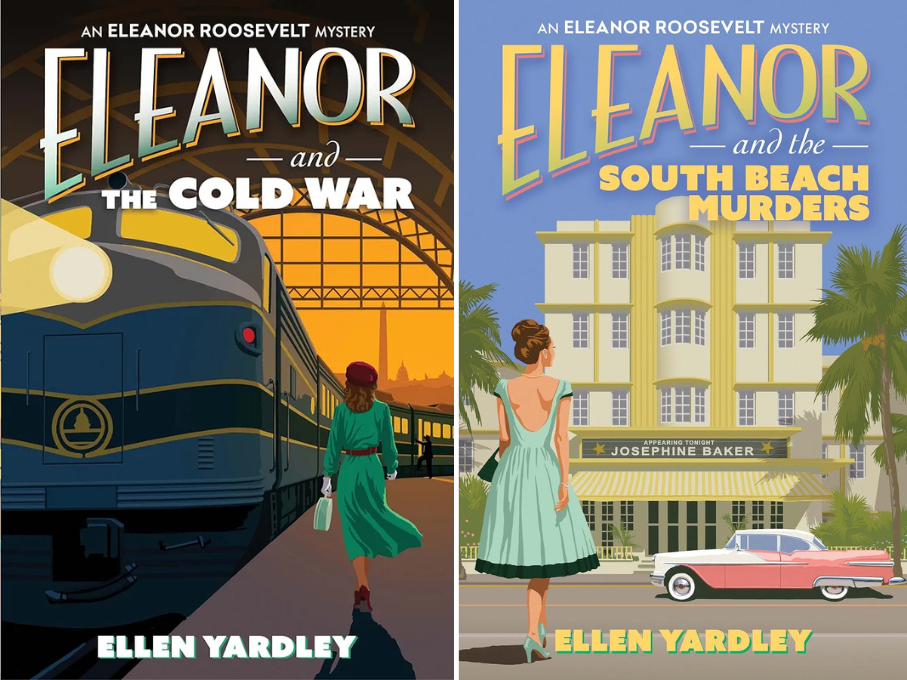
The Eleanor Roosevelt Mystery Books 1-2
Award-winning, bestselling author Ellen Yardley writes the Eleanor Roosevelt Mystery Series. This historical mystery series features a female sleuth who is also an indispensable assistant to former First Lady Eleanor Roosevelt.
Book 1 is Eleanor and the Cold War
Book 2 is Eleanor and the South Beach Murders
Cozy Crime Reads Interview with Ellen Yardley
What attracted you to the cozy mystery genre?
As a reader, I became hooked on cozy mysteries when I was a teenager, and my mother introduced me to Agatha Christie’s mysteries. We were visiting family in England at the time, and I spent every day in the local bookstore, buying Agatha Christie novels.
Cozies make murder into a challenging puzzle to solve without violence or gore. Often the murder victim may be an unsympathetic character, which makes it easier to simply enjoy guessing who did it.
Solving the mystery is the fun of a cozy, but it is the characters and setting that attract me. Cozies always have a sympathetic narrator. The narrator may be facing a personal struggle—starting over after a divorce, building up a business, recovering from a major upheaval—and solving the murder helps the narrator grow and find her/his place in the world.
As a writer, I love creating a mystery with a surprising and satisfying twist. I work to surprise readers with a “double twist”, where the reader expects one twist, and doesn’t expect the second one.
When I had the opportunity to write my cozy series, the Eleanor Roosevelt mysteries, beginning with Eleanor and the Cold War, I challenged myself to create a twisty mystery while capturing the amazing personality of Eleanor Roosevelt, the former First Lady.
What are a few of the essential elements that make a cozy stand out to you as a reader?
While I love Agatha Christie’s Hercule Poirot and Miss Marple, my favorite Christie is Crooked House, which doesn’t feature one of her well-known detectives, but has an engaging amateur detective as the narrator. An engaging and sympathetic narrator is an essential element.
An inviting setting is another important element of a cozy. Agatha Christie’s The Moving Finger embodied what I love about cozy mysteries. The narrator, Jerry, moves to a country house in a small village with his sister. We see the village setting through his eyes. He is a fish out of water in a world of social visits and tea parties, but as he and his sister fall in love with village life, the reader does too. Cozies feature a world that we want to live in. A country village. An elegant estate. A cozy café. Another element I love is how a cozy mystery involves people finding their tribe—i.e. finding the place they belong, finding friends, and sometimes finding love.
Do you have a favorite amateur sleuth?
I have many favorites including Rhys Bowen’s Lady Georgiana, Vanessa Kelly’s Emma Knightley (a mystery series sequel to Jane Austen’s Emma), Colleen Cambridge’s Phyllida Bright who is Agatha Christie’s fictional housekeeper, and S.J. Bennet’s Queen Elizabeth as an amateur detective. My favorite character in S.J. Bennet’s stories is Prince Philip, and she crafts a delightfully cozy, affectionate relationship between the Queen and Prince Philip.
What inspired your first cozy mystery?
I’d written twenty romance novels and decided to make a change. My romance novels usually included a mystery because I enjoy them so much. To my good fortune, my agent told me that my publisher, Kensington Books, was interested in a mystery series involving former First Lady Eleanor Roosevelt, wife of President Franklin D. Roosevelt. My agent suggested me for the series, and I had the opportunity to pitch a proposal which was accepted.
How do you research and create the “cozy” elements in your books, like the settings and community?
Writing about Eleanor Roosevelt involved a great deal of research. I decided to set the series in the early 1950s. Eleanor Roosevelt had left the White House and was working as a delegate to the United Nations where she played an instrumental role in the creation of the Universal Declaration of Human Rights.
I read many biographies on Eleanor Roosevelt, as well as her autobiography. Mrs. Roosevelt wrote a newspaper column called My Day, that was published six days a week from 1935 to 1961, then three days a week until September 1962. This was a great source of information for her activities and a great place to become familiar with her voice.
The community I created for Eleanor includes several fictional characters. Her fictional secretary Kay Thompson is her sleuthing companion, and she is helped by fictional police detective Tim O’Malley. I use actual historical figures in the books such as John F. Kennedy, Robert F. Kennedy, Jacqueline Bouvier (later Jacqueline Kennedy), and Josephine Baker.
Setting the series in the 1950s gave me the chance to carry out fun research into fashion, makeup, furniture and automobiles of the period.
What is one key step in your writing process that helps you transform an idea into a finished book?
I usually start with a simple idea. For Eleanor and the Cold War, I envisioned Eleanor Roosevelt discovering the body of a young woman on a train. For Eleanor and the South Beach Murders, I envisioned a locked door mystery with two people in the room. One was the victim, and the other was innocent. How could that be?
Writing a synopsis is the key for me to move from those early ideas to a finished book. Unlike an outline, which is point-by-point, a synopsis tells the complete story in a short version and allows the character voices to come through. By writing a synopsis, I know where the story is going, how the plot develops, and what clues Eleanor and Kay use to solve the murder. Since the synopsis is short, about six single spaced pages, I have room in the book to expand ideas and have fun with dialogue and description, confident that my plot is sound.
One other key thing I always do is to write the last line of the book first. At a writing workshop I attended, an author described a story as hurtling toward the last line. Writing the last line gives me the theme of the book. It helps me see where the characters end up. That helps me understand the story journey they must make, which helps me plot. And because I write that line before anything else, I have no constraints. The “blank slate” allows me to think freely about where the story should go.
What advice would you give aspiring cozy mystery authors who want to start writing their first novel?
Persevere! Writing can be a lot of fun when you are creating characters, inventing their dialogue, and plotting the twists in a mystery. When we read a book, it feels effortless. And easy. But when you begin writing, it feels like the wonderful ideas in your head aren’t translating to the page.
Writing is mainly about re-writing. I accept that I write many drafts of a book. I will usually write four full drafts, and individual chapters can have as many as ten drafts. A first draft can be disappointing. But I have learned to have faith in the process. There is always a wonderful moment when I feel the book has come together and the story “blossoms like a flower”.
Just keep working at it, is the best advice I can give.
How can readers connect with you online?
Readers can connect with me on social media on Facebook and Instagram.
Facebook at https://www.facebook.com/EllenYardleyWrites
Instagram at https://www.instagram.com/ellenyardleywrites/
Please check out my website at www.ellenyardley.com for book information and excepts.
There, readers can learn about my Eleanor Roosevelt mystery series.

Eleanor and the Cold War (An Eleanor Roosevelt Mystery Book 1)

Eleanor and the South Beach Murders (An Eleanor Roosevelt Mystery Book 2)
This page contains affiliate links. Cozy Crime Reads may earn a small commission if you click on a link and make a purchase. This happens at no extra cost to you.